Sunset Times in Crete: A Month-by-Month Proposal Planning Guide
If you are proposing in Crete, the single most useful number is what time the sun goes down — and how long you have afterwards. Here is the month-by-month table, and how to build the evening around it.
Almost every proposal question we are asked eventually reduces to one thing: what time does it get dark?
It sounds prosaic. It is actually the whole plan. The light decides when you walk, when you kneel, when the photographs work and when they stop working, and whether the evening afterwards happens in daylight, at dusk or under stars. Get the timing right and everything else has room to breathe. Get it wrong and you are proposing in the dark at eight o'clock or standing about in full sun at seven.
So here are the numbers.
The table
Approximate times for Chania, taken mid-month. Elsewhere on the island shifts by a few minutes — Elounda and Agios Nikolaos, being further east, run about six or seven minutes earlier than Chania.
| Month | Sunset | Light effectively gone |
|---|---|---|
| January | 17:33 | 18:02 |
| February | 18:05 | 18:32 |
| March | 18:31 | 18:56 |
| April | 19:56 | 20:23 |
| May | 20:21 | 20:50 |
| June | 20:40 | 21:11 |
| July | 20:39 | 21:09 |
| August | 20:13 | 20:40 |
| September | 19:31 | 19:57 |
| October | 18:48 | 19:14 |
| November | 17:17 | 17:44 |
| December | 17:12 | 17:40 |
Two things jump out.
The clocks change at the end of March, which is why March to April looks like a ninety-minute leap. It is not — it is an hour of that plus the season. And the latest sunsets are in late June, not August, which surprises people planning a high-summer trip.
The window you actually care about
Look at the second column. From sunset to the light being properly gone is only about half an hour — twenty-seven minutes in August, thirty-one in June. That is your entire golden window, and it is shorter than almost everyone assumes.
Inside that half hour the light does three distinct things. For the first ten minutes the sun is down but the west is still burning, and everything is warm and orange. For the next ten it cools into pink and violet and the sea goes silver — this is the best light of the day for photographs and it is the shortest. For the last ten it drains to deep blue, the first stars appear, and any artificial light you have arranged starts doing the work.
If you are proposing, aim to be in position fifteen minutes before sunset, not at sunset. You want the walk, the arrival and the settling to have already happened, so that the moment itself lands in the second phase rather than the first.
Building the evening around it
Say you are proposing in late September. Sunset is 19:31, light gone by 19:57.
Be at the spot by 19:15. Propose around 19:35 to 19:40, in the pink. You then have twenty minutes of falling light while it sinks in, which is exactly the right amount of time — long enough to feel like something, short enough that nobody starts wondering what happens next.
And then something should happen next. This is the part people underplan. A proposal at 19:40 leaves you standing on a headland at 20:00 in the dark with a very happy partner and nowhere to go, and a restaurant booking an hour later is a slightly deflating answer.
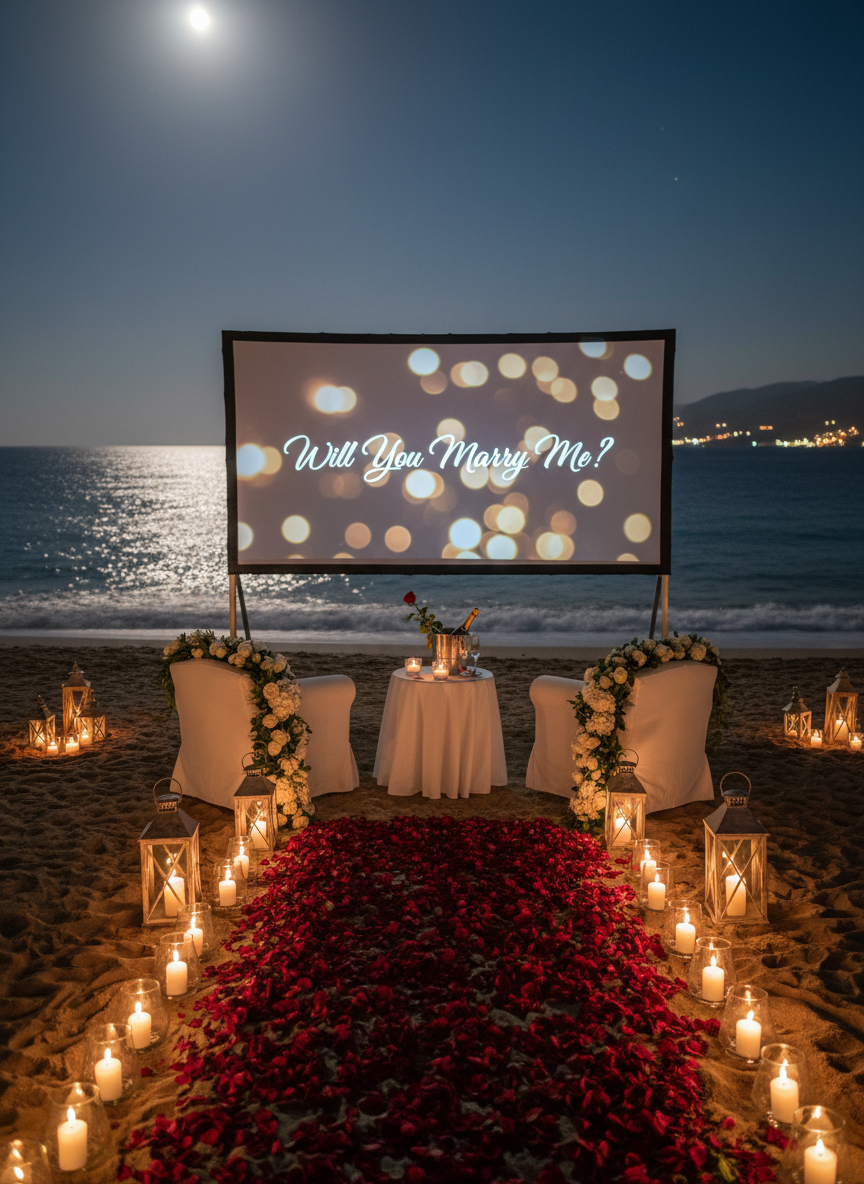
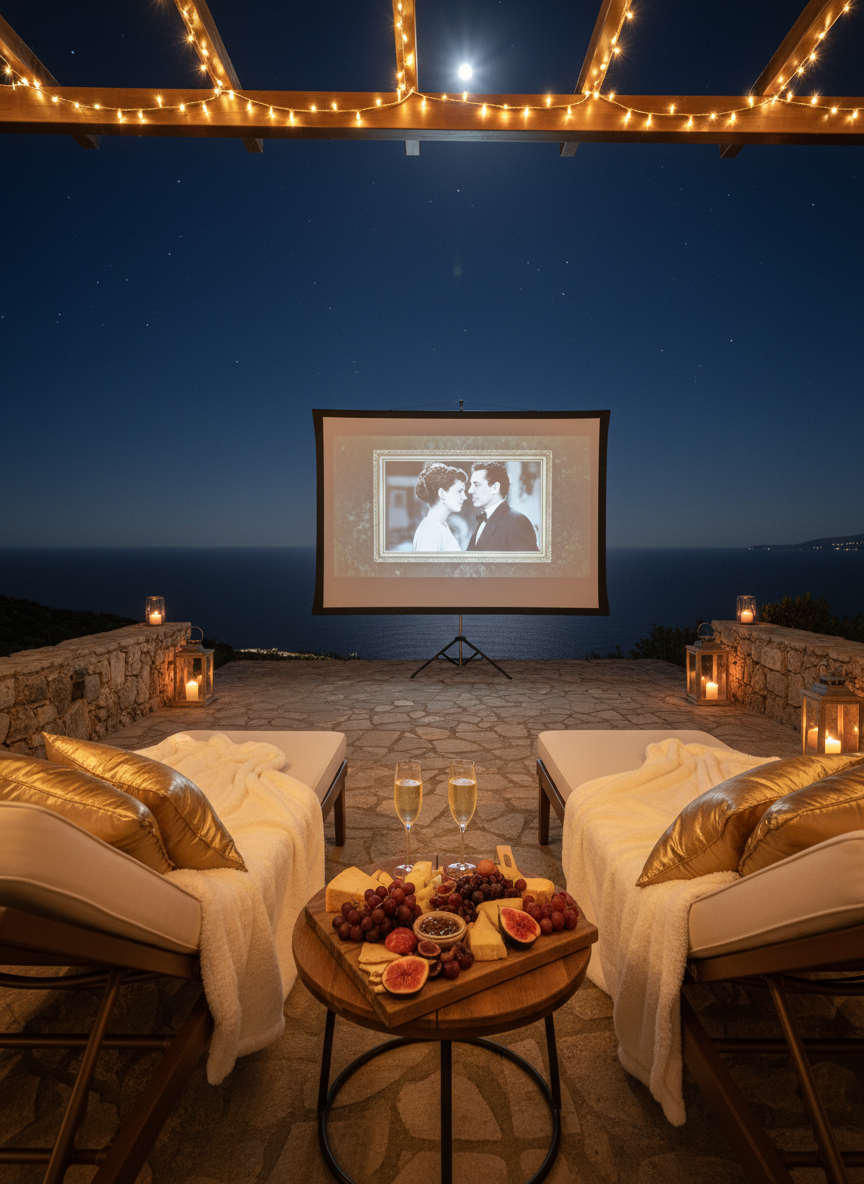
It is why we built The Proposal the way we did. Everything is set up in advance and out of sight — the styling, the illuminated letters, the candles — and the evening flows straight from the moment into a cinema under the stars on your own terrace, with the film you choose and nobody else there. The timings sit inside the table above rather than fighting it: we set up in the afternoon while you are out, we are invisible during the moment, and the screen comes on once the light has gone.
For a high-summer proposal the same logic runs an hour later. For an October one, everything moves earlier and the evening is longer, which is one of several reasons autumn is quietly the best proposal season in Crete — warm sea, thin crowds, and dark by seven.
A few practical notes
Times drift by a minute or two either side of mid-month, so check your exact date before you commit to anything. Cliffs and mountains matter more than the almanac — a west-facing terrace keeps the sun several minutes longer than a spot with the White Mountains behind it, and a north-facing cove can lose the light twenty minutes early. Go and stand in the actual place, at the actual hour, on a day beforehand. It is the single most useful thing you can do.
If you are still choosing where, we have written about the nine best places to propose in Crete, ranked by privacy, and a fuller guide to planning the proposal itself.
And when you know your date, tell us — we will work the whole evening back from the sunset time and tell you honestly whether it hangs together.
Written by Mark · Founder, Starlight Cinema Crete
Starlight for Two — €690
An evening like this, at your own villa
A private cinema under the Cretan stars, set up for dusk and collected at midnight. You choose the film; we do everything else.
Not ready yet?
Join the waitlist
Still deciding? Leave your email and we will keep you posted on available dates and early-season offers.
Check availability
Reserve your evening
Every evening includes the 200-inch screen, cinema sound, luxury seating, a popcorn bar and a discreet host — set up, styled and packed away without you lifting a finger. Tell us your date and we will reply within 24 hours.
Weather promise. If the night turns, we rebook your screening free — you never lose your evening.
Book without risk. Free cancellation up to 48 hours before your evening. No deposit taken until your date is confirmed.
One crew, few evenings. We host a limited number of screenings each week, so summer dates are allocated first come, first served.