Chania at Night: A Local's Evening Itinerary
Most visitors do Chania at night in one direction: harbour, dinner, bed. Here is how the evening actually unfolds if you let it — hour by hour, from the light going gold to the last drink by the sea.
Most visitors do Chania at night in a single straight line. They walk down to the Venetian harbour at eight, eat at whichever table has a view of the water, walk the same curve back, and go to bed thinking they have seen it. They have seen the postcard. The town is better than the postcard, and the difference is almost entirely a matter of timing and direction.
Here is how the evening actually unfolds if you let it.
Around eight: the harbour, but early
Go down before you are hungry. Sunset in Chania slides from around half past eight in early August to just after seven by the end of September, and the twenty minutes before it is the only time the harbour looks like the thing everyone photographs — the Venetian arsenals turning honey-coloured, the water going flat and pink, the whole arc of the waterfront lit from the side rather than from above.
Walk out along the mole to the lighthouse. It is longer than it looks from the shore, about fifteen minutes each way over uneven stone, and worth every step because it is the only place you can see the entire old town at once with the White Mountains stacked up behind it. Wear something other than flip-flops. Then walk back into town before the harbour restaurants fill, because you are not eating here.
Nine: Splantzia, when the square fills up
Cut inland. Splantzia is five minutes from the water and a different town entirely — a wide square under an enormous plane tree, tables spilling out from three sides, the church of Agios Nikolaos standing there with a bell tower on one flank and a minaret on the other, which tells you most of what you need to know about who has owned this island.
This is where Chania eats when Chania is not showing off. The square is loud in the good way by half past nine: families at the long tables, someone's grandmother holding court, kids running between chairs long after they would be in bed anywhere else. Nobody will rush you. Nobody will hand you a laminated menu with photographs on it.
Ten: the lanes are the point
After you eat, do not go back the way you came. The old town between Splantzia and the harbour is a knot of lanes barely wide enough for two people, and getting slightly lost in them after dark is the single best thing Chania offers for free.
You will find courtyards with a single lit tree in them. Doorways with three centuries of different stonework stacked above the lintel. A leather workshop still open at eleven because the owner felt like it. Streets that dead-end into a wall and streets that open without warning onto the sea. Give it forty minutes and no destination. This is the part people remember six months later, and it is the part nobody plans.
Eleven: the sea at your back
Two directions from here, depending on the night you want.
West, to Nea Chora — the town beach, a ten-minute walk along the shore. Tables practically on the sand, the sound of the water underneath the conversation, a much younger and more local crowd than the harbour. Good for a long slow drink when you have eaten too much and want the air.
East, to Koum Kapi — the stretch of seafront just outside the old Venetian wall, where the bars face open water rather than a harbour basin. It is where people go when the evening is not finished at eleven. In late summer you can still sit outside comfortably at one in the morning here, which is not something you can say about many places.
If you have a car and an early start does not frighten you, the coast road east towards Kalyves and Almyrida in Apokoronas puts you in villages where the tavernas sit right on the water and nobody is running a night for tourists at all.
The night you stay in
Here is the honest bit. A week in Chania does not want seven nights out. Somewhere around night four, the walk into town starts to feel like an obligation, the children are tired before they will admit it, and the thought of finding parking is worse than the thought of the meal.
That is the night the villa earns its keep. It is also the night most people waste — a scratch dinner, phones out, everyone drifting off to separate rooms by ten.
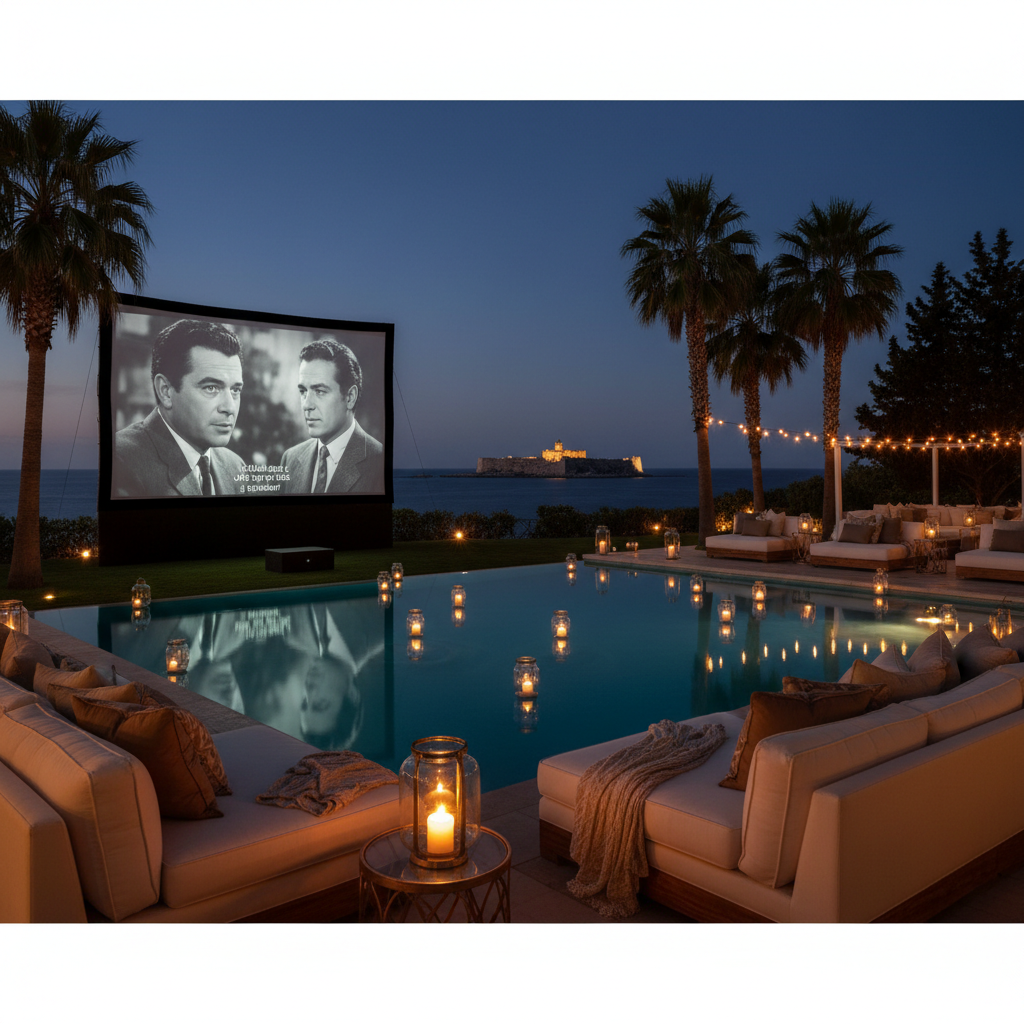
It does not have to go that way. We build a private open-air cinema on the terrace: a two-hundred-inch screen, proper cinema sound, styled seating with cushions and blankets, popcorn, and a host who runs the whole evening so nobody in your group has to. We arrive in the late afternoon, and by midnight it is gone as though it was never there. Any film you like. Fifteen people or two.
If you want more ideas for the evenings you spend at the villa rather than in town, we have written fifteen of them here. And if you are still deciding where in Crete to base yourself, this guide compares Chania, Rethymno and Elounda on the things that actually matter.
Do Chania properly on the nights you go out. And on the nights you stay in, do that properly too.
Written by Mark · Founder, Starlight Cinema Crete
Not ready yet?
Join the waitlist
Still deciding? Leave your email and we will keep you posted on available dates and early-season offers.
Check availability
Reserve your evening
Every evening includes the 200-inch screen, cinema sound, luxury seating, a popcorn bar and a discreet host — set up, styled and packed away without you lifting a finger. Tell us your date and we will reply within 24 hours.
Weather promise. If the night turns, we rebook your screening free — you never lose your evening.
Book without risk. Free cancellation up to 48 hours before your evening. No deposit taken until your date is confirmed.
One crew, few evenings. We host a limited number of screenings each week, so summer dates are allocated first come, first served.